scroll down to listen to sermons. click on the highlighted link.
The beatitudes are sayings that introduce a sermon preached by Jesus recorded in Matthew's Gospel. They are part of a larger sermon, eight sayings that begin with the phrase "Blessed". Two book ends, "for theirs is the kingdom of heaven" sets the tone: the blessed are those that are the citizen's of God's kingdom, those that are seeking God's kingdom. This is a key teaching in Jesus' preaching. The word for "Blessed" is the word meaning happy or fortunate, but carry the connotation that these people are happy not because their circumstances are good or bad but because they have been blessed by God, divine favor has been bestowed on them, God's divine approval. What comes as a surprise is that they are complete opposites of what we normally value as humans. Happy and blessed are not the powerful, the wealthy, the strong, and the armed. Rather the poor, those that mourn, the meek, the peacemakers, those that hunger for justice, the merciful, the pure in heart, and the persecuted. This is the last installment of a sermon series looks at each of these beatitudes as we seek to understand what it means to live under God's heavenly kingdom, the gracious and loving rule of God.
From the Campus of Calvin College, Inner Compass is a program that provides important interviews exploring how people use faith and ethics to guide them through critical questions in life. In this interview, Inner Compass interviews Elias Chacour, Archbishop of the Melkite Greek Catholic Church. He recounts a story of how he locked his warring parishioners in the church on Palm Sunday and confronted them with a choice, reconcile together or die as a community.
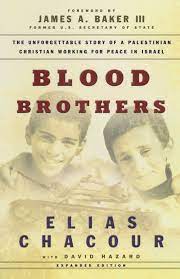
Archbishop Elias Chacour originally recounted this amazing transformation of his small parish of the Melkite Greek Catholic Church in the Holy Land in the book "Blood Brothers". In this interview, he also tells of his passion and work towards reconciling Jewish, Muslim and Christians in the Holy Land and the many issues of civil and human rights facing the Palestinian citizens living there today. He is an advocate not a two-state solution, but a one-state solution, that is a nation that is democratic and secular (in that it protects the religious freedom of all its citizens). He ends his interview with this statement regarding the conviction that both Palestinians and Israelis often hold that the land belongs exclusively to one group, "we have to stop believing that the land belongs only to them (whichever group claims it) it belongs to God, and they have to belong to the land, not make the land belong to them." He recalls a time when Jewish, Christian, and Muslim lived together in harmony and believes that respect for the rights of all is the only way forward today.
His story stands as a beacon of hope for all Christians as well as the struggle for civil rights of Palestinians in the Holy Land.
In my reading experience, "Blood Brothers" stands out in its exceptionality on multiple levels. A gripping personal account of a Palestinian Christian's journey stemming from the birth of the modern state of Israel. The author, Elias Chacour tells the harrowing story of how that decision would impact his family, church, village and community. He recounts his journey into Christian ministry, his reflection on the Beatitudes and the significant challenges facing Muslims, Christians, and Jews living in the Holy Land today.
As I have been preparing a series of sermon's on the Beatitudes, I have struggled with their meaning. This teaching of Jesus is clearly an attitude that we as Christians are called to adopt. Yet in honesty, how can we really live like this? Is it really possible to exhibit the qualities of the Sermon on the Mount? Elias Chacour faced this very question. This gripping first hand account of Elias to come to terms with the application of the Beatitudes to a real life crisis and tragedy is a must read for all Christians. Furthermore, it recounts an important and often neglected perspective in the current Middle Eastern crisis facing our world. This book is significant for the geo-political considerations alone, but at its root, it provides so much more! At its core it explores what it means for us to live according to the Beatitudes. It also holds out the hope that religions of the world like Christianity, Islam and Judaism can all coexist peacefully, in fact, it is essential that people of faith learn to live with each other.
This book is available from Amazon or other on-line and retail book sellers.
The beatitudes are sayings that introduce a sermon preached by Jesus recorded in Matthew's Gospel. They are part of a larger sermon, eight sayings that begin with the phrase "Blessed". Two book ends, "for theirs is the kingdom of heaven" sets the tone: the blessed are those that are the citizen's of God's kingdom, those that are seeking God's kingdom. This is a key teaching in Jesus' preaching. The word for "Blessed" is the word meaning happy or fortunate, but carry the connotation that these people are happy not because their circumstances are good or bad but because they have been blessed by God, divine favor has been bestowed on them, God's divine approval. What comes as a surprise is that they are complete opposites of what we normally value as humans. Happy and blessed are not the powerful, the wealthy, the strong, and the armed. Rather the poor, those that mourn, the meek, the peacemakers, those that hunger for justice, the merciful, the pure in heart, and the persecuted. This sermon series looks at each of these beatitudes as we seek to understand what it means to live under God's heavenly kingdom, the gracious and loving rule of God.
Presbyterianism is a branch of Christianity that began during the Reformation. This was a time of great theological development as well as political, social and religions upheaval. John Calvin, a lawyer who had studies for the priesthood, converted to the reformed movement in 1533. He became an influential leader in the Protestant Reformation in Europe. His influential "Institutes of the Christian Religion" outline his theological ideas. John Knox, was a Scot turned reformer, who studied under Calvin. He returned to Scotland, where he played an important role in the Protestant Party's 1560 revolution and the adoption of the Scots Confession by the Scottish Parliament. The Reformed and Presbyterian movements grew in Europe, and Presbyterians were among many of the first to arrive at the shores of New World. This short video, picks up the story of the history of the Presbyterian Church in the continental United States. It is in many ways, a story of break ups and hook ups, but demonstrates the diverse nature of the Presbyterian church as well as its contributions to the American culture. It is part of a series for new members developed by the Presbyterian Church (U.S.A.)
As we approach Reformation Sunday next month, it is a good time to reflect on our own heritage and that of the Protestant Reformation. Among the benefits, the Reformation brought the Bible into the language of the people, it has allowed for greater participation of the laity in the life of the church, and new theological emphasis, but it also brought about schism and divisions in the body of Christ. Let us continue to pray for the unity and peace of the church while we celebrate the good the reformation brought.
A few notable characteristics of Presbyterianism:
Belief in the sovereignty of God
Emphasis on the grace of God
Baptized Christians are stewards of God's creation
Social justice is an outflow of the Gospel of Jesus Christ
Education is important because all truth is God's truth
Church polity recognizes checks and balances to keep corruption in check
(art in the Christian Tradition used by permission)
Gracious God, you sent your son Jesus Christ in the power of the Spirit to redeem your people. Unite us in our diversity, that we might affirm and proclaim together the good news of the life, death and resurrection of Christ for a world in need of his gospel. Amen.
Pope Francis enter at 24:00, Processional begins at 40:00
I've posted this link (third party site) from the Vatican of Mass at Madison Square Garden with Pope Francis. One of the emphasis for this blog has been Christian worship. I have maintained that there are close similarities between Catholic and Protestant worship. Although there are significant differences, some of the similarities can be observed at this Mass. While some of the differences are theological, the form of worship between Catholic and Historic Protestantism are very close. (Liturgical and Sacramental Traditions such as Lutheran, Episcopal, and Presbyterian).
The word Mass simply refers to this central act of worship in which the Eucharist is celebrated, it originates from the latin text of the priests dismissal of the congregation at the end of the liturgy (dismissal/missal/mass). The service is often referred to as simply the Mass, or the Holy Sacrifice of the Mass. It appears that from the earliest of time, the church always met and celebrated Holy Communion, although this practice dropped off during the Middle Ages. Most Christians rarely celebrated, and (1215) the Fourth Lateran Council required communion at least once a year. It was during the Reformation that reformer John Calvin called for a return to the practice of weekly celebration of Holy Communion. Today, most Christians denominations have returned to the weekly practice. That is to say, a worship service is always a service of both Word and Sacrament. I have highlighted the main movements of the service below. The theme of this Mass was justice and peace.
The altar area was covered in very simple white linens, and the papal chair or throne (cathedra) which represents the church's teaching authority and unity, was very simple in its design. Green vestments were worn as the season is currently Ordinary Time.
In the sermon, Pope Francis stated that "Jesus still walks our street", he spoke of the peace of Christ that comes to those who walk with Christ. "He frees us to walk the path of peace." He went on to say that "God lives in our cities, and our church must live in our cities."
24:00 The Pope enters Madison Square Garden 40:00 Opening Processional begins (Processional Hymn All Creatures of our God and King) 47:00 Invocation/Greeting 47:49 Penitential rite (Prayer of Confession)/Kyrie Eleison 56:11 Alleluia/Gospel Acclamation Liturgy of the Word 57:16 Gospel Reading 1:01:00 Homily (Sermon) 1:16:00 Silent reflection 1:18:00 General Intercessions (Prayer of the People) Liturgy of the Eucharist 1:23:00 The Presentation of the Gifts 1:25:00 The Consecration of the Elements/Incensing of the Altar 1:30:00 Sanctus 1:33:00 The Words of Institution 1:35:00 Eucharistic Prayer 1:40:00 Sign of Peace (Passing of the Peace) 1:41:00 The Breaking of the Bread Pope Francis: Behold, the Lamb of God who takes away the sins of the world. Blest are those who are called to his supper. All: Lord, I am not worthy to receive you, but only say the word and I shall be healed. 1:43:35 Holy Communion 1:53:00 Communion Hymn "Alleluia Sing to Jesus" 2:00:00 Concluding Rite (Prayer After Communion) 2:01:55 Announcements (Timothy Dolan Archbishop of New York addresses Pope Francis) 2:07:33 Blessing and Dismissal 2:10:09 Recessional Hymn "Now Thank We All Our God"